
Hey Sisters,
This week, let’s talk about the invisible weight many of us carry. It’s that feeling of being perpetually strong, endlessly resilient, yet deeply tired. It’s the pressure we’ve normalized and the pain we’ve been taught to ignore. We’re talking about intergenerational trauma and its close cousin, PTSD.
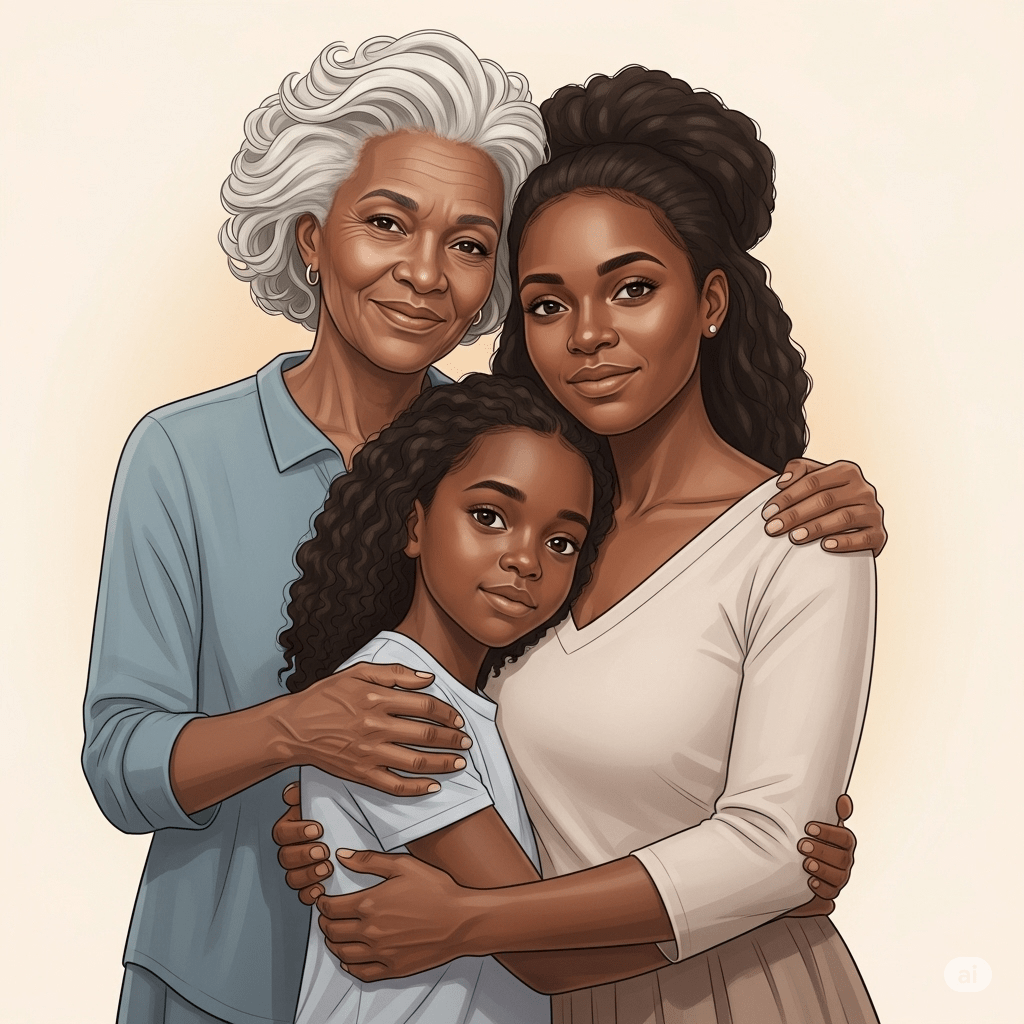
As Black women, we are often forced to embody the “Strong Black Woman” archetype. It’s a shield that protects us but also prevents us from healing, making it all too easy to pass our unaddressed wounds down to our daughters.
But that cycle can end with us. Let’s break it down by understanding what this trauma looks like, the real-world effects it has on our minds and bodies, and how we can finally begin to heal.
What Does Intergenerational Trauma Look Like for Us?
Intergenerational trauma is the transmission of a traumatic experience from one generation to the next. It’s the echo of our ancestors’ pain, manifesting in our own lives. For us, it often looks like:
- Weathering: A term first coined by public health researcher Dr. Arline Geronimus in 1992, “weathering” describes the premature biological aging our bodies endure from the cumulative stress of racism and discrimination. It’s why our bodies are literally keeping the score.
- “Tough Love” as a Survival Tactic: Think of the authoritarian parenting style where mistakes are punished harshly and there’s little room for soft emotions. This isn’t a lack of love; it’s often a fear-based strategy passed down from mothers who had to prepare their daughters for a world that would not be kind to them.
- The Parentification of Daughters: This is the unspoken rule that the eldest daughter (or any daughter) must become a second mother. She’s expected to carry adult emotional and household burdens, sacrificing her childhood because her mother was likely forced to do the same.
- The Culture of Silence: This is the heavy, unspoken agreement not to discuss painful family secrets, especially things like sexual assault, addiction, or mental illness. This silence doesn’t heal the wound; it only hides it, allowing the pain to fester across generations.
- Perfectionism as a Shield: This is the deeply ingrained belief that we must be flawless in everything we do just to be seen as worthy or to stay safe. It’s the voice that says, “You have to be twice as good to get half as far,” leading to crippling anxiety and burnout.
- Justified Mistrust in Systems: This is the protective skepticism we hold toward institutions that have historically harmed us. Whether it’s the doctor who dismisses our pain, the legal system that fails to protect us, or the employer who overlooks us, our mistrust is a learned and logical survival response.
The Toll on Our Minds and Bodies
These inherited patterns aren’t just ideas; they have tangible and serious consequences.
The physical toll is staggering. “Weathering” isn’t just a theory; it’s a reality seen in our health statistics. According to the CDC, nearly 60% of Black women over the age of 20 have high blood pressure, and we are almost twice as likely as white women to be diagnosed with diabetes. This is the physical price of carrying generations of stress.
Mentally, the weight of these traumas can manifest as Post-Traumatic Stress Disorder (PTSD)—a condition where our minds and bodies remain in a state of high alert long after the danger has passed, marked by intrusive memories, anxiety, and emotional numbness.
More commonly, it shows up as a quiet exhaustion. It’s the pressure to excel at work, be the perfect partner, raise brilliant children, and be the unshakable pillar for our entire community, all while putting our own needs last. It affects how we show up every single day, often forcing us to pour from an empty cup.
How We Begin to Heal: Breaking the Cycle
Our trauma does not have to be our daughters’ inheritance. The journey to break the cycle is personal and powerful, and it starts with a single decision to do things differently. Here’s how we can begin:
- Acknowledge and Name It. We cannot heal what we do not acknowledge. Read the list above again. Which patterns feel familiar? Naming these traumas, whether in a journal, to a trusted friend, or to yourself in the mirror, removes their silent power.
- Observe Your Triggers and Behaviors. Once you’ve identified the trauma, notice how it shows up in your life. When you feel a surge of anger, what just happened? When you shut down emotionally, what triggered it? Recognize these reactions, explosive anger, emotional detachment, chronic mistrust, feelings of worthlessness, not as flaws, but as survival signals.
- Choose a New Response. Unlearning a behavior starts with choosing a new one. This is a moment-by-moment practice. When you feel the urge to retreat into silence, can you try sharing one small feeling with someone safe? When perfectionism causes anxiety, can you allow yourself one moment of rest or imperfection? It’s about taking small, intentional steps.
- Seek Support. This journey is not meant to be walked alone. Find a culturally competent therapist who understands the nuances of our experience. Join a support group. Lean on the sisters in your life who are also on this path.
This is a deep and often slow process. It requires unlearning behaviors that once kept our ancestors alive. But we don’t have to be defined by our past. By healing ourselves, we heal the generations that came before us and liberate the ones who will come after.
You are not in this alone.
Sources:
- Geronimus, A. T. (1992). The weathering hypothesis and the health of African-American women and infants: evidence and speculations. Ethnicity & Disease, 2(3), 207–221.
- Centers for Disease Control and Prevention (CDC). (2023). Health of Black or African American Population. https://www.cdc.gov/nchs/fastats/black-or-african-american-health.htm
 Her Melanated Mind
Leave a comment